The AEO Shift: Why Healthcare’s New AI Search Rules Are a Major Win for Doctors
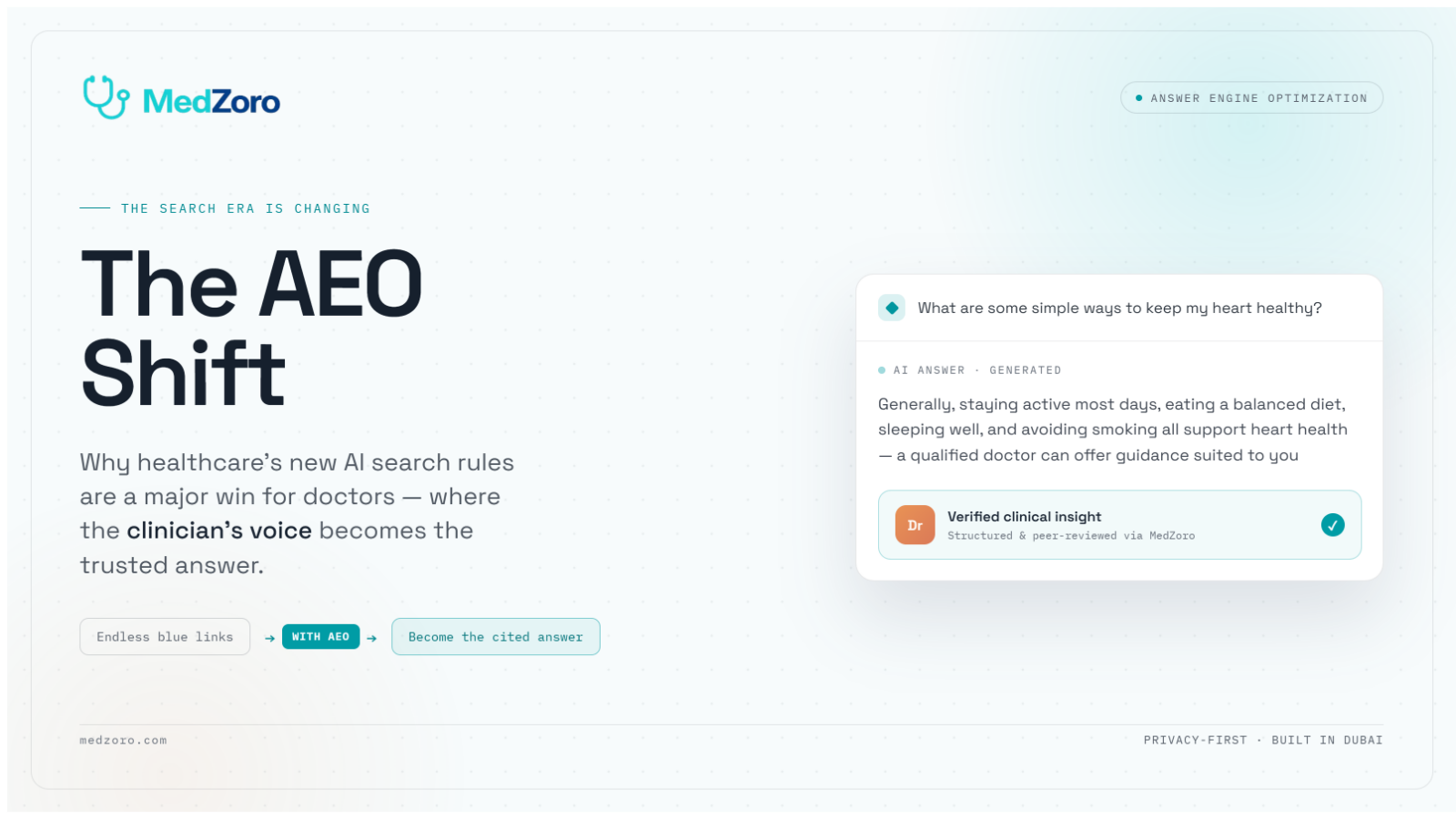
Search is shifting from SEO to Answer Engine Optimization. Here's why AI-driven search rewards clinical accuracy and puts doctors' expertise back at the center.
Medzoro
Empowering doctors in the digital world
For years, digital marketing agencies have handed doctors a heavy, generic playbook: (Write a massive 4,000-word Ultimate Guide to knee pain. Build backlinks. Wait six months for Google’s algorithms to rank you.)
For a physician running a busy clinic or finishing a 12-hour shift, this traditional SEO model felt like a second full-time job. It demanded massive amounts of time that doctors simply do not have, resulting in a digital world where generic wellness blogs often outranked real clinical voices.
But the digital landscape has shifted. Traditional, link-heavy search engine optimization is rapidly transitioning into a new era: Answer Engine Optimization (AEO). Driven by Large Language Models (LLMs) and Google’s evolving AI Overviews, patients are no longer clicking through ten blue links. Instead, they are asking direct questions and receiving synthetic, AI-generated summaries.
For the medical community, this shift changes everything. AEO represents an era where clinical accuracy and authoritative expertise matter more than pure marketing volume.
From Ranking to Becoming the Answer
In the traditional search era, success meant ranking on page one. In the AEO era, success means (becoming part of the answer) generated by AI systems.
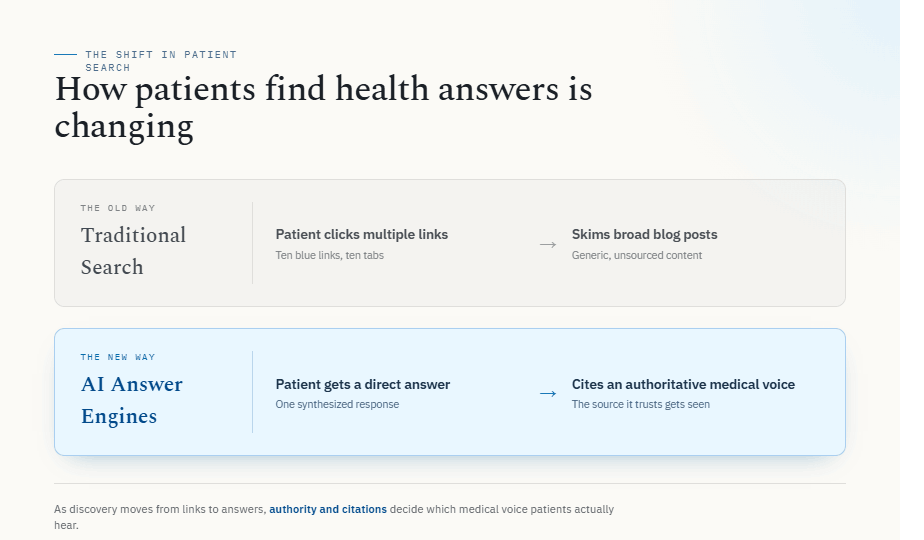
When a patient asks an AI, (What are the early warning signs of cardiovascular distress vs. standard acid reflux?), the engine doesn’t look for the longest blog post. It searches for the most precise, trusted, and structured clinical explanation available.
Because AI engines pull information from authoritative sources, the old strategies of mass-producing shallow content or buying high-authority backlinks are losing value. Instead, AI engines prioritize highly specific, data-rich insight.
The Three Pillars of Healthcare AEO
To establish a strong digital presence today, healthcare professionals need to adapt their digital outreach across three main areas:
1. Content: Niche Precision Over "Ultimate Guides"
AI models are trained to summarize broad topics themselves, meaning they have little use for another generic article on "Healthy Eating." What they look for are hyper-specific, persona-centric answers.
Instead of writing broad overviews, physicians should focus on specific patient scenarios, localized medical nuances, and structured clinical observations. For example, structuring insights around "Post-operative recovery timelines for active adults over 50 after a meniscus repair" gives an AI engine the precise data points it needs to cite a professional medical voice.
2. Technical: Making Medical Insights AI-Readable
AI bots ingest data differently than traditional search crawlers. To ensure clinical content is easily understood by AI engines, it must be structured intentionally.
Use direct Q&A formats within headings and text.
Ensure each section of a page or post is semantically complete (meaning it provides a full, contextual answer on its own).
Utilize proper healthcare schema types (backend code that tells search engines exactly what kind of medical information is on the page).
3. Offsite: Conversational Authority on Trusted Platforms
Traditional SEO relied heavily on link-building. AEO, however, prioritizes positive brand mentions across the platforms where AI models train and gathers real-time data. For modern medicine, this means having a presence where patients actively discuss health: platforms like YouTube and Instagram.
When a doctor’s insights are consistently highlighted, discussed, or watched on these platforms, AI engines recognize that name as a trusted authority in that specific medical field.
Visibility is the New Metric that Matters
For years, healthcare digital success was measured by website traffic. But AI search changes user behavior. Patients often get the exact medical clarity they need directly inside the AI interface. They might not click through to a clinic's website immediately; instead, they may open a new tab days later to book an appointment once they trust the name they kept seeing.
Because of this non-linear patient journey, healthcare communication must prioritize Visibility and Share of Voice over immediate click-through rates.
The Quality Advantage: Early data across digital platforms shows that traffic arriving directly from AI engine citations converts significantly better than traditional search traffic. Why? Because by the time a patient clicks a link within an AI answer, they have already completed their initial research. They aren’t just browsing; they are ready to book a consultation.
Empowering the Clinician’s Voice with MedZoro
At MedZoro, we believe this AI-driven evolution is the best thing to happen to medical communication in a decade. It strips away the need for doctors to act like generic content marketers and puts the focus back on what they do best: providing accurate, reliable medical expertise.
Our mission is to empower doctors to navigate this complex digital world safely, effortlessly, and effectively.
Capture Clinical Insight: Takes under 5 minutes. After a long shift, a doctor dictates or notes a quick, hyper-specific clinical insight or patient FAQ.
AI Structure & Optimization: Clinician-Led & Safe. MedZoro’s AI-powered assistant structures the text into precise Q&A formats, optimizing it for AI answer engines while strictly adhering to medical advertising norms.
Peer Review Safeguards: Trust First. The content is verified against guardrails designed by practicing healthcare professionals to ensure patient safety and clinical accuracy.
Multi-Platform Publishing: Amplifying Share of Voice. With one click, the post is formatted and scheduled across modern platforms, building the positive offsite mentions that AI search models rely on.
Technology as an Assistant, Doctor as the Author
We know that medical rules are complex, risks are high, and time is scarce. That is why MedZoro is built on a Privacy-First foundation right here in Dubai, ensuring full compliance with regional healthcare communication standards. We never train shared AI models on private clinical inputs.
Most importantly, our technology acts strictly as an assistant. It augments the clinical voice rather than replacing it, leaving the physician as the definitive author of every word published.
The era of writing massive, keyword-stuffed articles for search engines is over; the era of providing clear, precise, and verified answers for patients has arrived. In 2026, Answer Engine Optimization (AEO) and Retrieval-Augmented Generation (RAG) reward direct, clinical clarity over marketing ambiguity. To build a robust digital entity that satisfies both healthcare consumers and AI search crawlers, medical content must pivot from generic long-form prose to structured, question-and-answer architecture. By delivering exact, credential-backed insights that mirror real-world clinical consultations, physicians transition from chasing traditional search algorithms to becoming the definitive, trusted sources that AI engines actively select and quote.